
Chapter 6.3
The Balance Sheet
How to read what the business owns, what it owes and what is left for the owners on any date; how to compare two dates; and what the notes and system checks under the statement tell you.
When you finish this chapter you will be able to:
- State the accounting equation and find it on the statement.
- Read current and long-term items, and work out working capital and the current ratio.
- Compare the balance sheet on two dates.
- Explain retained earnings and net income year to date, using the notes.
Assets = Liabilities + Equity
Everything the business owns was paid for either by someone it owes (liabilities) or by its owners (equity). The two sides always balance:
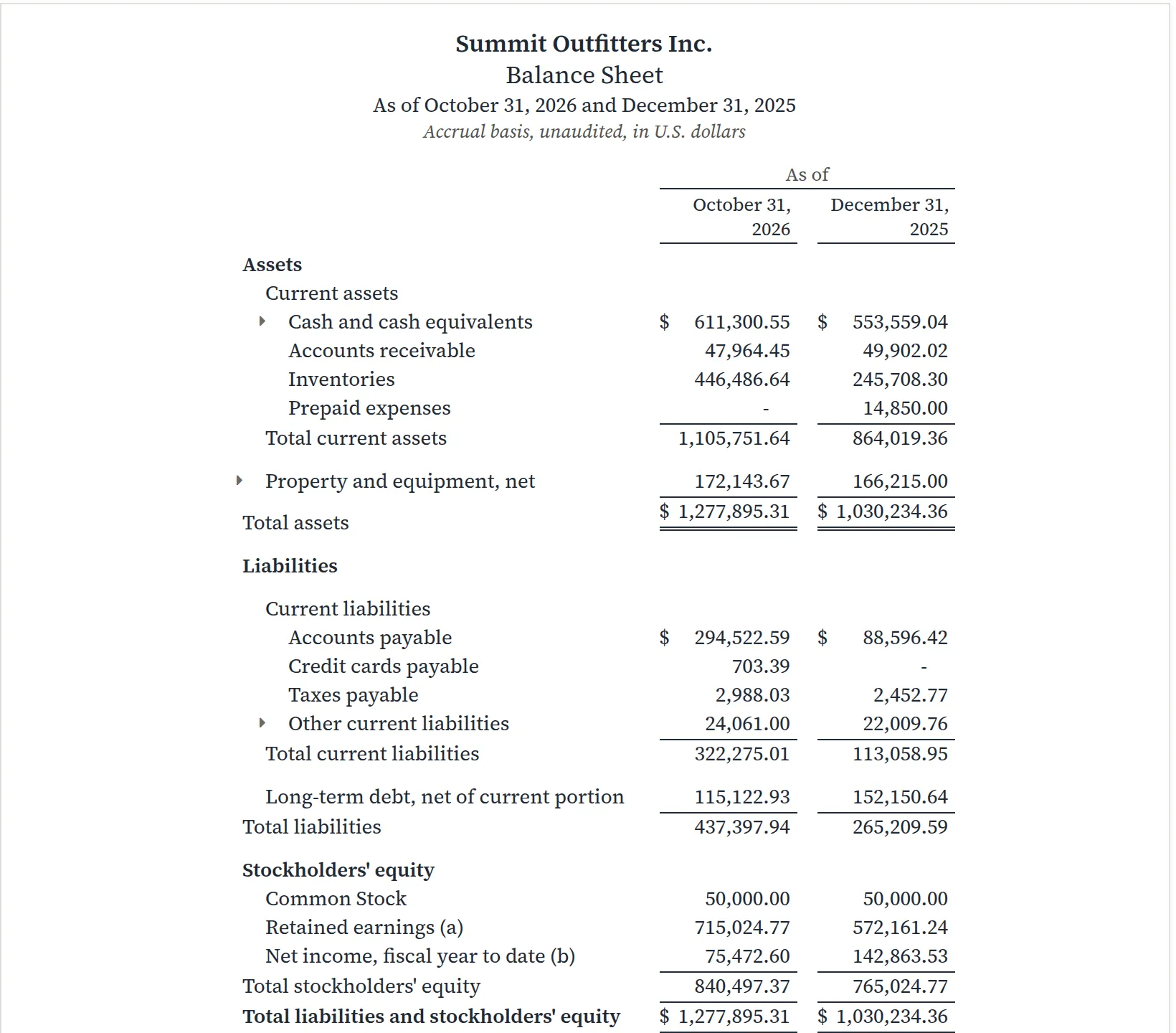
$1,277,895.31 assets = $437,397.94 liabilities + $840,497.37 equity
Unlike the Profit and Loss, which covers a period, the balance sheet is a snapshot of one date.
Run and read it
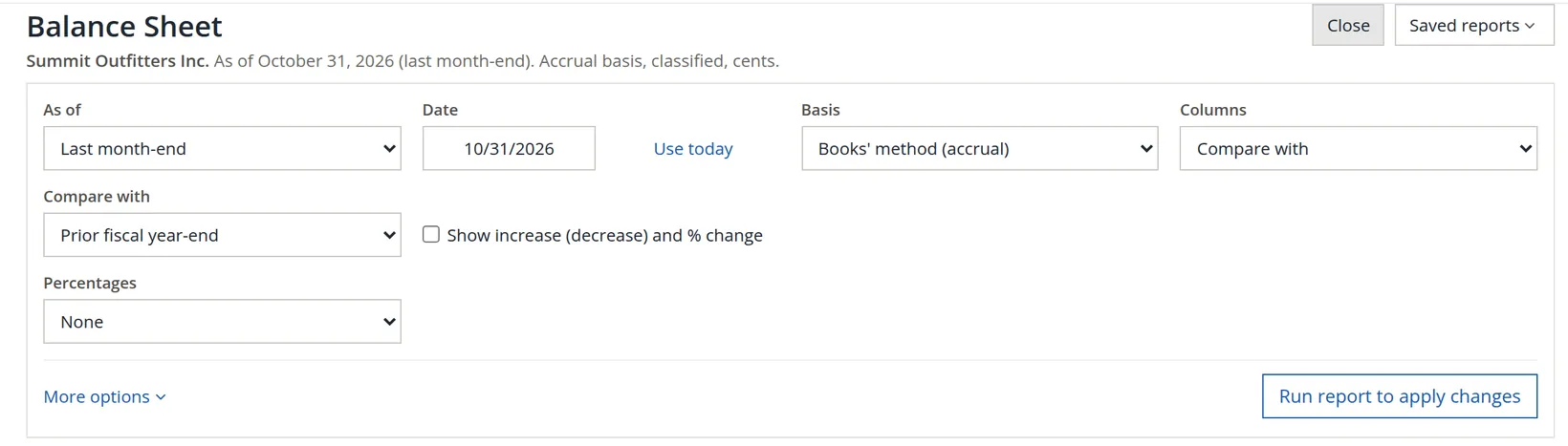
Reports → Balance Sheet opens as of the last month-end. Click Change report to choose the date and a comparison.
| Measure | Oct 31, 2026 | Dec 31, 2025 | Reads as |
|---|---|---|---|
| Working capital | 783,476.63 | 750,960.41 | More cushion than at year-end |
| Current ratio | 3.43 | 7.64 | Still strong, but payables rose sharply |
| Inventories | 446,486.64 | 245,708.30 | Stock built up for the winter season |
Before trusting a balance sheet, check that cash agrees with the reconciled bank statements (Chapter 4.4), accounts receivable with Aged Receivables (Chapter 6.6), and accounts payable with the unpaid bills list (Chapter 3.2). If those three tie, most of the statement is right. The Report information box under the statement (Section 2) already compares receivables and payables for you, and cash with the ledger; the bank reconciliation is still yours to do.
The notes and system checks
Under the statement, notes explain how it was prepared. Note (a) explains that retained earnings on the statement are built from past years' results, even before the books are closed, so they can differ from the retained earnings account in the ledger ($541,297.44 here). Note (b) gives the dates behind "net income, fiscal year to date".
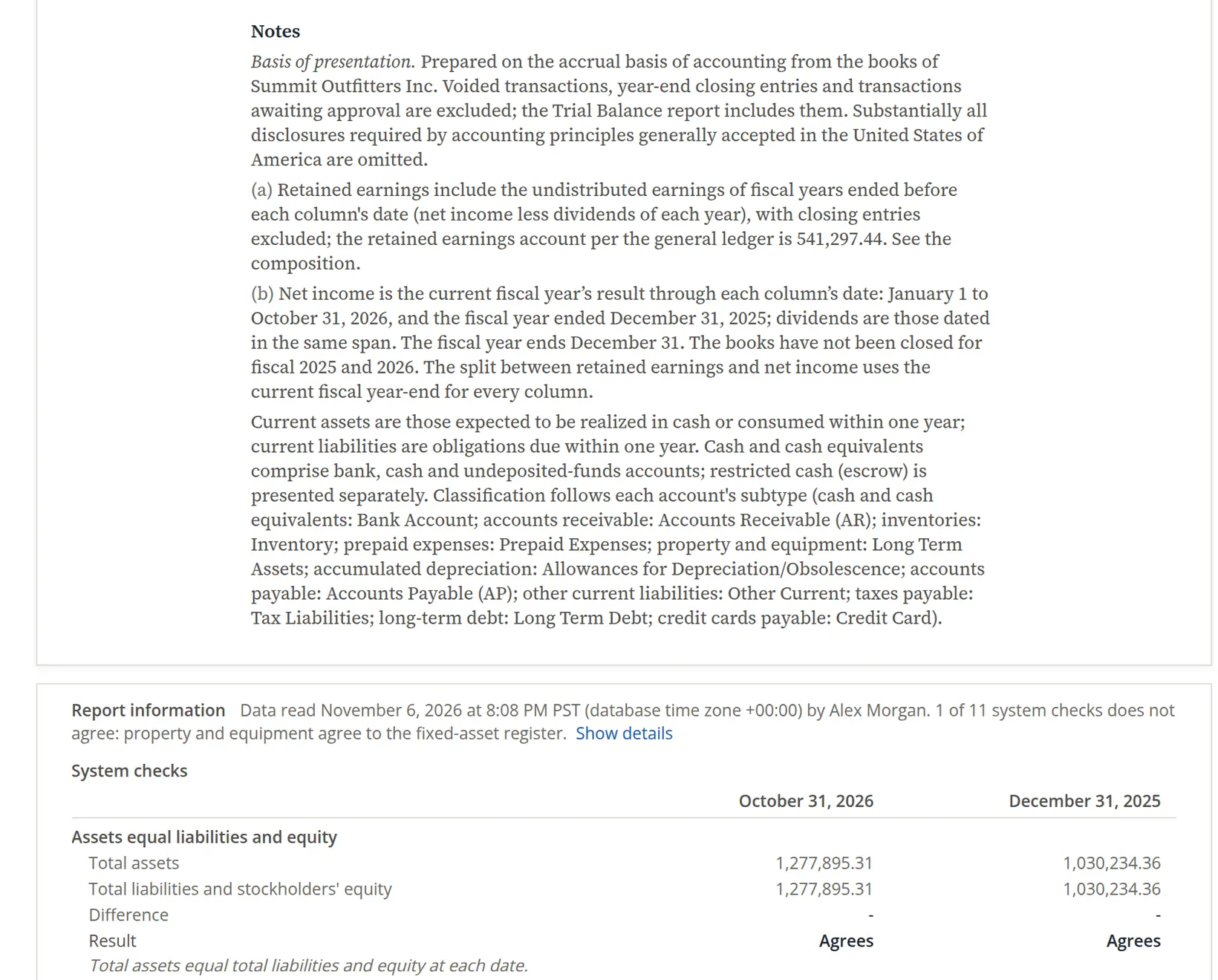
The Report information box at the bottom says when the figures were read and by whom, and lists the system checks BizBooks360 ran on this statement. There are eleven, in two kinds.
| Kind | Checks | If one fails |
|---|---|---|
| The statement itself | Assets equal liabilities and equity; the statement foots; account balances agree to the trial balance; ledger in balance; net income agrees to the Profit and Loss; retained earnings roll forward; every account has a statement line | The statement is marked Draft: its own figures cannot be relied on |
| Tie-outs to the detail records | Cash accounts agree to the general ledger; receivables agree to the aged receivables; payables agree to the open bills; property and equipment agree to the fixed-asset register | The statement stays final; the detail record behind one balance disagrees with the ledger and needs looking into |
When every check agrees, the box is a single line, "All system checks agree", and the table waits behind Show details. When a check fails, the line names it and the System checks table opens under it without being asked. That is what Summit's box shows now.
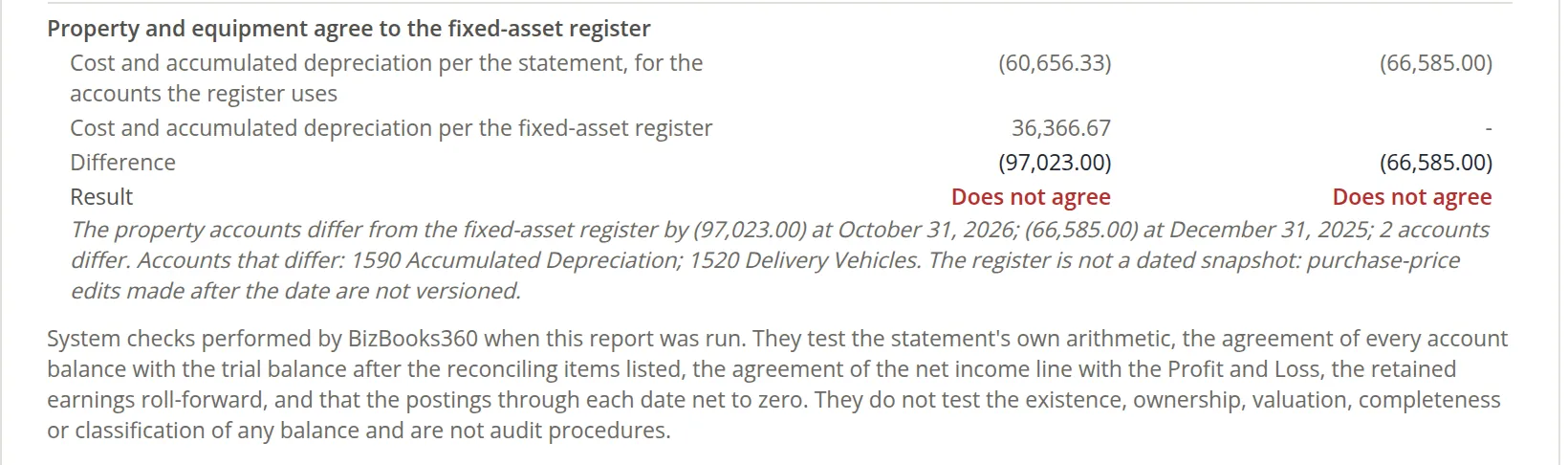
Read it honestly. The statement is not wrong: the ten other checks agree, and this one does not mark the statement Draft. What it says is that the fixed-asset register does not account for everything in the property accounts. Summit owned assets before it used the Fixed assets page, and their cost and depreciation were posted by journal entry and never entered on the register. Chapter 10.1 shows the same gap from the register's side: Accumulated Depreciation differs by $135,523.00 and Delivery Vehicles by $38,500.00, and (135,523.00) + 38,500.00 = (97,023.00), the figure here. The cure is to bring the older assets onto the register (Chapter 10.1, Procedure C), not to post an entry that makes the numbers meet.
"All system checks agree" means the report is internally consistent and agrees with the books' own records. As the box itself says, the checks do not test whether a balance exists, belongs to the company, is valued correctly or is complete. They are not an audit.
Check your understanding
1. Total assets are $1,277,895.31 and liabilities $437,397.94. What is equity?
Answer
$840,497.37 (1,277,895.31 − 437,397.94).
2. Why does the balance sheet show "net income, fiscal year to date" separately from retained earnings?
Answer
Because this year's result has not yet been closed into retained earnings; it is shown on its own until year-end.
3. Which three balances should you tie to other records every month?
Answer
Cash to the bank statements, receivables to the aged receivables, payables to unpaid bills.
4. The Report information box says "1 of 11 system checks does not agree: property and equipment agree to the fixed-asset register." Is the Balance Sheet wrong?
Answer
No. That check is a tie-out to a detail record; it does not mark the statement Draft. It means the fixed-asset register is missing assets that the ledger carries, so the register needs completing (Chapter 10.1).