
Chapter 6.4
The Statement of Cash Flows
Why profit and cash are not the same thing, and how the Statement of Cash Flows explains the difference: operating, investing and financing cash, by the indirect or direct method.
When you finish this chapter you will be able to:
- Explain why a business can be profitable and short of cash, or the reverse.
- Name the three sections of the statement and give an example of each.
- Read the indirect method's reconciliation from net income to cash.
- Run the statement, compare periods and check that it ties to the ledger.
Profit is not cash
The Profit and Loss counts income when it is earned and costs when they are incurred. Cash moves on other days: customers pay later, stock is bought before it is sold, equipment is paid for at once but expensed over years, loans come in and go out. The Statement of Cash Flows explains, line by line, how net income became the change in cash.
| Section | What it covers | Examples |
|---|---|---|
| Operating | Running the business | Customer receipts, payments to suppliers and staff; changes in receivables, inventory, payables |
| Investing | Long-lived assets | Buying a van or equipment; selling one |
| Financing | Owners and lenders | A bank loan received or repaid; owner contributions and draws; dividends |
Run and read it
Reports → Cash Flow Statement.
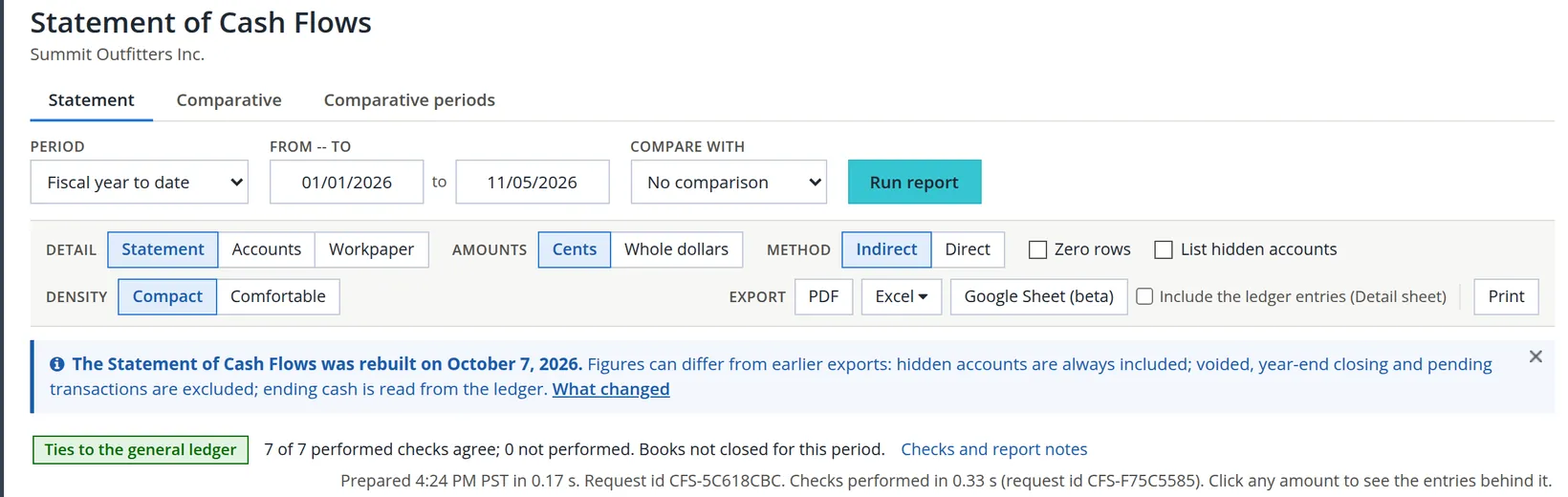
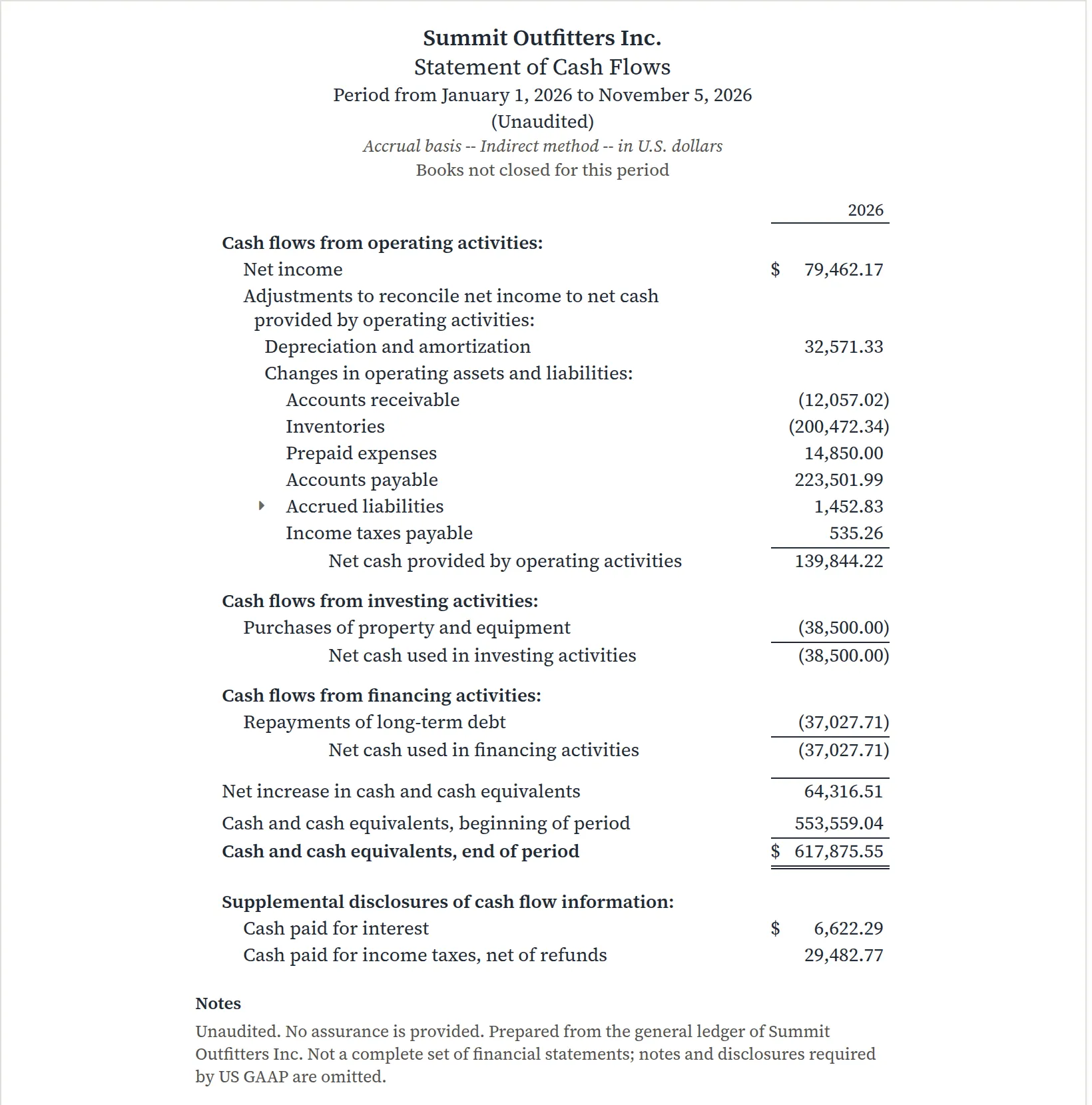
Reading this example. Summit earned net income of $79,462.17 so far this year, yet its operations produced $139,844.22 of cash. The indirect method explains the gap line by line. Depreciation of $32,571.33 was an expense, but no cash left the business, so it is added back. Inventories rose by $200,472.34: cash went into stock not yet sold, so the rise is subtracted, and so is the $12,057.02 rise in receivables, income not yet collected. Accounts payable rose by $223,501.99: most of the new stock was bought on credit and has not been paid for, so that rise is added back. Three smaller items complete the reconciliation: prepaid expenses used up, $14,850.00; accrued liabilities, $1,452.83; income taxes payable, $535.26.
In figures: 79,462.17 + 32,571.33 − 12,057.02 − 200,472.34 + 14,850.00 + 223,501.99 + 1,452.83 + 535.26 = $139,844.22.
Summit then spent $38,500.00 on equipment (investing) and repaid $37,027.71 of its bank loan (financing): 139,844.22 − 38,500.00 − 37,027.71 = $64,316.51, the increase in cash. Added to the $553,559.04 held on January 1, it gives $617,875.55 on November 5, the balance of the bank accounts in the ledger, including the two trust accounts. When the bills for the winter stock are paid, cash will fall and the payable will shrink.
Is the business generating cash from operations? Is it investing in its future? Is it living on borrowed or owners' money? A healthy, growing business usually shows cash in from operations, cash out for investing, and modest financing either way.
Check your understanding
1. In which section does buying a delivery van appear?
Answer
Investing activities.
2. Receivables rose by $20,000 this year. Does that add to or subtract from operating cash under the indirect method?
Answer
It subtracts: income was recorded but the cash has not arrived.
3. Who can run this report?
Answer
The company's owner, and any member whose Statement of Cash Flows row in Users and permissions allows viewing.
Notes
- Since November 2026 the Statement of Cash Flows is held to Users and permissions (Chapter 15.7) like every other report: the owner, and any member whose Statement of Cash Flows row allows viewing, can run it. A member without that permission still sees "Your role in this company cannot run this report. Ask the company owner." Earlier editions said only the owner could run it and took the pictures from Summit Gear Repair; the practice user is a member of Summit Outfitters Inc. with the permission, so the pictures now come from there. ↑
- The pictures and every figure quoted in this chapter are from November 5, 2026, when all seven checks agreed. Entries made since then change the amounts, and the statement now has an extra Credit cards payable line, so a statement you run today will not show these exact numbers. For the same reason the Profit and Loss in Chapter 6.2 (to October 31) shows a different net income from the one here. When a check does not agree, the chip carries a DRAFT tag and names the check, the statement's heading says what it does not agree to, and a red banner above the statement gives the difference and the accounts behind it, with See the check. A yellow banner warns when opening balance entries are dated inside the period: they are shown as a reconciling line, not as a cash flow, and usually belong before the first period you report. Summit's practice books show both banners at the time of writing: an opening-balance correction entry made on November 5 is read by the statement's checks as a conversion entry, so its expense line is left out of the statement's net income. The books themselves balance: that entry and the one it corrects net to 0.00 in Customer Credits. ↑